Something Big Is Happening, and Taste Is More Important Than Ever
The AI moment is accelerating fast. The real skill isn't producing more with AI. It's knowing what's good. This is the 10-80-10 framework.


TL;DR: The AI moment is accelerating fast, but panic isn't a strategy. The real skill isn't producing more with AI; it's knowing what's good. This is the 10-80-10 framework: you bring the first 10% (perspective), AI handles the middle 80% (research and drafting), and you bring the last 10% (taste). This post explains the framework and uses itself as the example.
Something Big IS Happening
If you've been anywhere near tech Twitter this week, you've probably seen Matt Shumer's essay, "Something Big Is Happening." It racked up over 82 million views. Fortune, CNBC, and Inc. all picked it up. The piece compares the current AI moment to February 2020, that brief window where a few people were sounding alarms about a spreading virus and the rest of us were going about our lives. His argument: we're in the "this seems overblown" phase of something much bigger.
And honestly? He's not entirely wrong.
On February 5th, OpenAI released GPT-5.3 Codex and Anthropic released Opus 4.6 on the same day. METR, the organization that benchmarks how long AI can work autonomously, now shows models completing tasks that would take a human expert nearly five hours. That number has been doubling roughly every seven months. NASA just announced that their Perseverance rover completed its first drives on Mars planned entirely by AI, using Claude to analyze orbital imagery and chart safe routes through boulder fields. The AI literally navigated another planet.
The pace is real. Let's not pretend otherwise.
But get this: the same week Shumer's essay went viral, researchers at UC Berkeley published a study in the Harvard Business Review that tells a different story. They spent eight months embedded at a 200-person tech company watching what happens when people actually use AI all day. What they found wasn't a productivity utopia. It was what they called "workload creep." Workers were faster, sure. They took on broader tasks: product managers started writing code, designers tackled engineering tickets. But the natural pauses in a workday disappeared. Every spare moment got filled with "just one more prompt." Lunch breaks shrank. Evenings blurred into work. The researchers concluded that the short-term productivity gains were masking cognitive strain and unsustainable intensity.
So which is it? Is AI the biggest opportunity of our lifetimes, or is it burning us out?
Both. And neither story is complete. Because there's a third thing happening that I think matters more.

The Thing Nobody's Talking About
AI slop is everywhere, and it's eroding trust.
You can feel it. The LinkedIn posts that all sound the same: polished, optimized, empty. The blog posts that hit every SEO keyword but say nothing a human would actually think. The PRDs and strategy documents that check every box but don't have a point of view. Code that compiles but nobody really reviewed.
We're in a moment where it has never been easier to produce content yet never been harder to produce content that matters.
The natural reactions are predictable. Some people reject AI entirely: "I write my own stuff, thanks." Others lean all the way in and lose their voice in the flood. I think neither approach really works. If you refuse AI, you're going to fall behind the pace (Shumer is right about that). If you surrender your thinking to AI, you become just another source of noise.
The question becomes: If I use AI to write, is it still mine? And the flip side: If I don't use AI, can I even keep up?
I've been sitting with this tension all week, and I have thoughts.
Snowboarding, Not Tumbling
This past week at work was packed. Back-to-back meetings. Several docs to write. Research to be done. This blog post to write. A year ago, a week like last would have felt overwhelming.
Instead, it felt a little like snowboarding.
Let me explain. Imagine everyone's standing at the top of the same mountain right now. The slope is steep, the speed is picking up, and there's no option to just stand still. We're so high up that you can't see the bottom through the clouds. But gravity's pulling you downward.

The AI moment is carrying all of us downhill whether we like it or not. Some people are tumbling. That's the Berkeley burnout: working faster, doing more, filling every gap with AI output until you're exhausted and your work all looks the same. Some people haven't even gotten off the lift yet, pretending the mountain isn't there.
But if you have a snowboard, if you've built an intentional system for how you work with AI, you can actually ride on the powder. Not perfectly. Not without the occasional wipeout. But with some control, some style, and your own line down the mountain.
My snowboard is a combination of the tools I've been building and sharing the past couple months. An Obsidian vault with thousands of notes that serves as my second brain. Claude Code as my thinking partner. Granola for capturing meeting notes. Daily briefs that help me process information instead of just accumulating it. I've been calling the whole system RonOS, and I've written about the pieces before.
But this week, the piece that mattered most wasn't a tool or automation. It was writing.
The 10-80-10 Framework
A mental model I came across recently that's resonated with how I use AI for creative work is called 10-80-10.
The first 10% is you. This is the framing. Your perspective, your lived experience, your point of view. You decide what to write and why it matters. You provide the context, the intent, the angle, the examples from your actual life. This is the part AI literally cannot do: nobody else had your week, saw the world from your perspective, or had your ideas walking home from work.
The middle 80% is AI. Research synthesis. First drafts. Outlining. Structuring your messy brain dump into something readable. Referencing your notes, your knowledge base, your prior work. This is where the speed happens. What used to take a full day can happen in an hour.
The last 10% is you again. This is taste. Reading the draft and knowing what's right and what's off. Cutting the generic parts. Adding the specific details that only you would know. Incorporating the nuance of what's happening that doesn't get written down. Rewriting the sentences that sound like a machine wrote them. Asking yourself: does this resonate? Does this sound like me? Would I say this to a friend?
Here's the key principle: AI should never be the first thinker. It should be the first drafter. If you skip the first 10%, if you just say "write me a blog post about AI productivity," you get slop. If you skip the last 10%, if you accept the first draft without editing for your voice, you get something competent but soulless. The magic is in the human bookends.
If you want to see this philosophy applied to building software specifically, I wrote a full walkthrough in The Degenerate's Guide to Vibe Coding.
I'll admit, this blog post was built using this framework (please don't click away! 🙏🏾). And I want to show you exactly what that looked like, because I think the gap between "use AI as a co-writer" and actually doing it well is where most people get stuck.
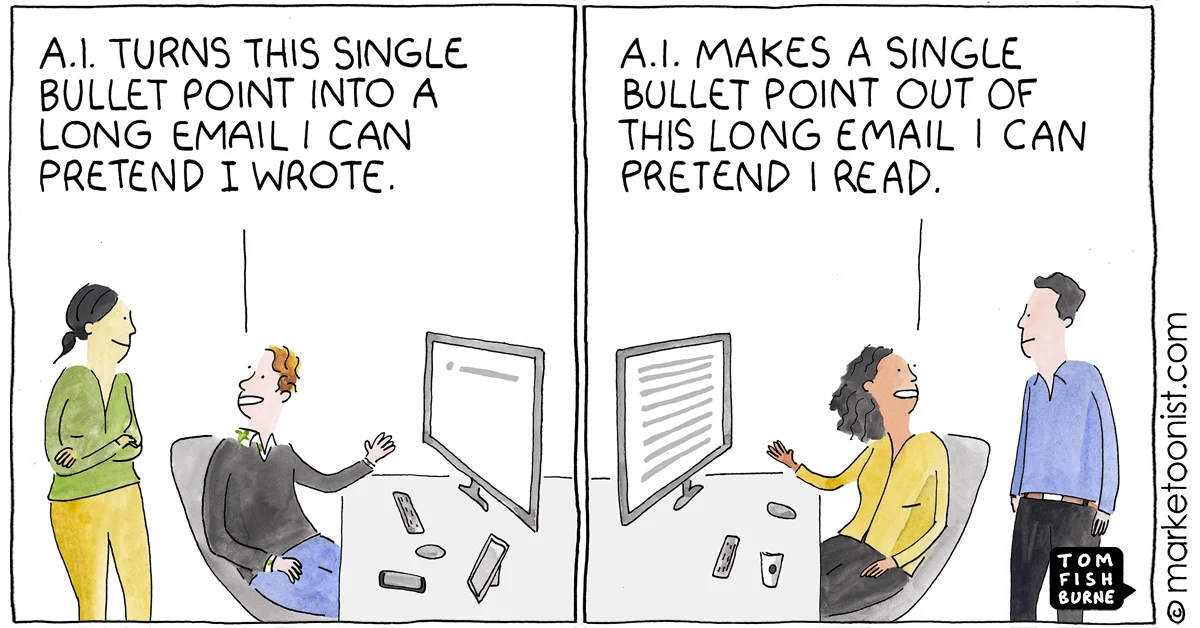
What Co-Writing Actually Looks Like
Most people think writing with AI is one step: give it a prompt, get a draft. That's how you get slop. Real co-writing is a conversation with distinct phases, and your voice stays in the loop at every transition.
One tip before I walk through the phases: use voice dictation for your inputs. I use Wispr Flow and Superwhisper. Talking is faster than typing, it's more natural, and it captures the way you actually think. Messy, associative, full of personality. Your spoken brain dump is better raw material than a carefully typed prompt. It sounds more like you, because it literally is you.
Here's the process:
Phase 1: Seed It
Start by dictating your raw topic ideas. What's been on your mind? What did you read this week that stuck with you? What are you reacting to? Don't organize it. Just talk.
AI takes that and goes to work: researching the topics, finding what's happening in the broader conversation, surfacing things you might have missed.
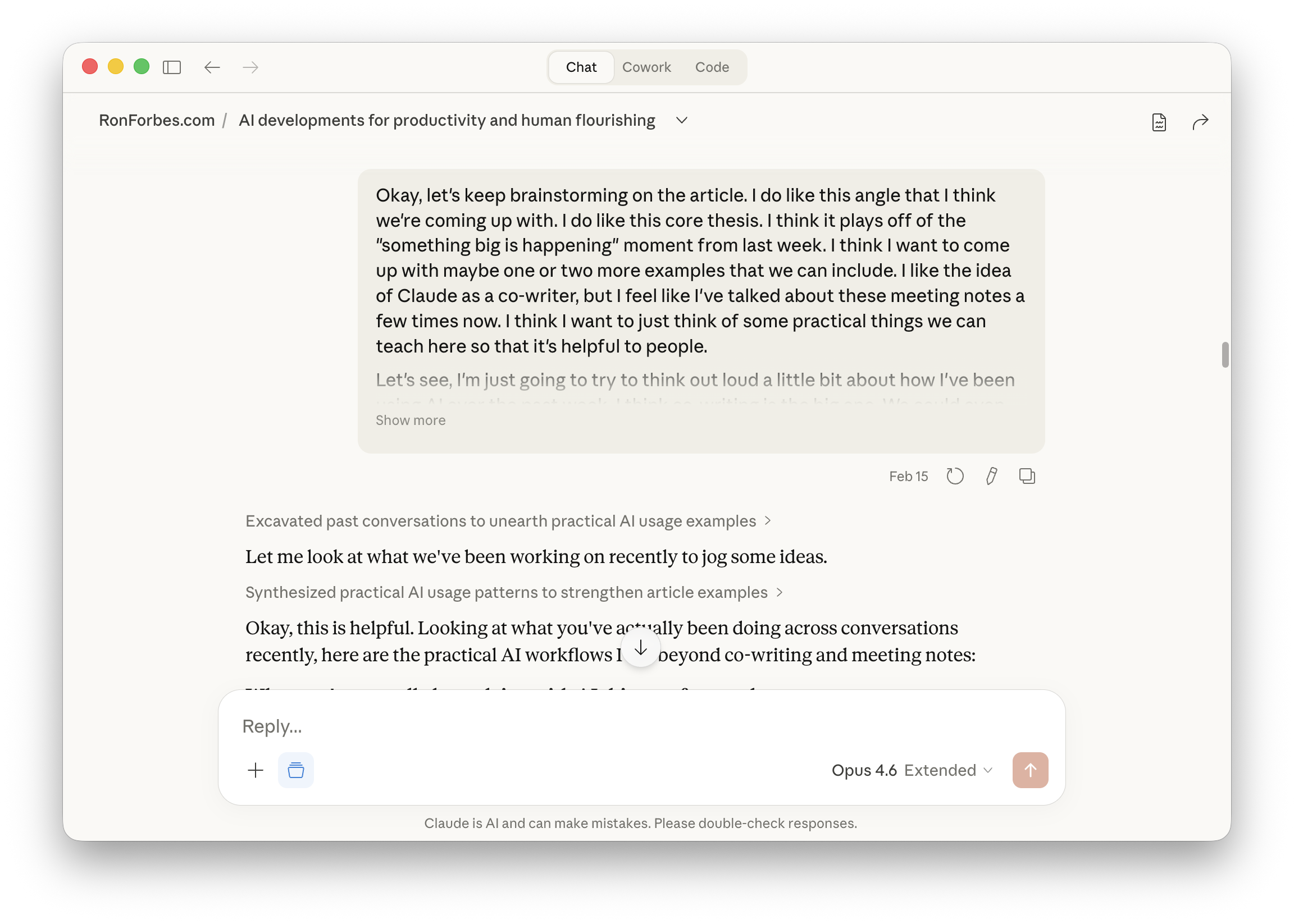
For this post, I started with: "It's time to start researching this week's blog post. What's going on in AI this week that would be worth writing about?" Claude suggested the Berkeley study, which then reminded me of the Shumer piece. That made Claude think of the Perseverance Mars story, and so on. Like a conversation with a helpful coworker, we bounced ideas back and forth until a central idea emerged.
Your role in this phase: you're the editorial director. AI brings you options. You decide and shape what's interesting.
💡 Pro Tip: Get outside for this part! Go on a walk, or go for a run. Research shows walking increases creative output by 60% compared to sitting, boosting divergent thinking and free flowing thought.
Phase 2: React
This is where most people skip ahead, and it's where the magic actually happens.
Dictate your reactions to the research. What resonates? What doesn't? What new ideas does it spark? What's your take? This is also where you bring in context from your own life: reference documents you've written, notes from meetings, prior work, specific experiences that connect to the topic.
For this post, I reacted to the research by saying something like: "I think there's this sense of AI-driven workflow creep, but this week I've been feeling oddly okay about it... it feels like I'm coasting on all the information rather than tumbling through it." That offhand reaction became a central metaphor for the post. Claude didn't generate that. I did. AI helped me see that it was the thesis.
This phase often goes several turns. That's normal. You're having a conversation, not issuing a command. Each turn sharpens the angle. In my case, the conversation evolved from "AI productivity" to "co-writing" to "taste" over the course of maybe six or seven exchanges. Don't rush it.
Your role: you're the thinker. AI is your sounding board.
Phase 3: Structure
When the angle feels right, ask AI to write an outline based on everything you've discussed.
AI organizes your conversation into a structure: sections, flow, narrative arc. Then you react to the outline. What's missing? What's in the wrong order? What needs more emphasis? What should be cut?
For this post, the outline went through several iterations. I asked for the 10-80-10 framework to be more prominent. I asked for this practical walkthrough section, because I realized the post needed to teach something concrete, not just philosophize. I pushed to add the taste angle when it wasn't there (more on that below).
Each push made it more mine.
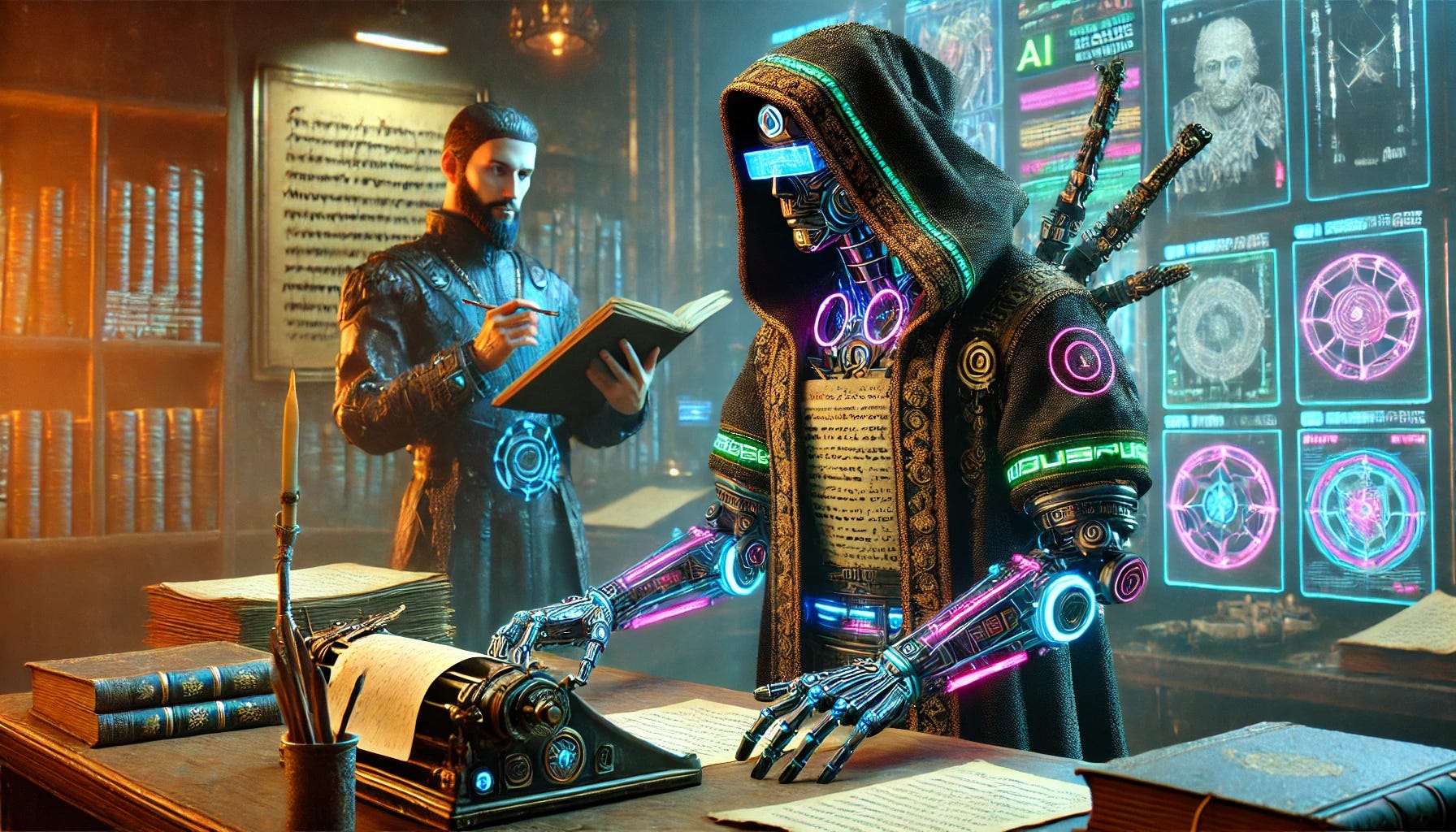
Your role: you're the architect. AI is your concept artist.
Phase 4: Draft
Now let AI write. The quality of this draft is directly proportional to the quality of phases one through three. If you did the thinking work upfront, the draft will be surprisingly close to what you want. If you skipped straight here, it'll read like every other AI-generated post on the internet.
Your role: you're the one who gave AI everything it needed to draft well.
Phase 5: Season to Taste
This is the longest phase and the most important one.
Read the draft carefully. Every single word. Dictate your feedback: what sounds right, what sounds generic, what's missing your perspective. You point at specific sections and say things like "this paragraph should sound more like how I'd explain this to a coworker" or "this section is filler, cut it" or "I wouldn't actually say it this way, here's what I mean."
AI revises. You read again. You react again. The draft gets closer to your voice with each pass.
This is where taste lives. You're reading for resonance: does this sound like me? Would I actually say this? What makes me cringe? What bores me? You're not just proofreading; you're listening for your own voice in the text and turning up the volume on it.
This phase takes as long as it takes. Several rounds is normal. The editing is what separates co-written content that feels authentic from AI-generated content that feels hollow.
Your role: you're the head chef. You're the one with taste.

The Meta Bit
This blog post was written using the exact process I just described. I brain-dumped my reactions to the Shumer piece and the Berkeley study. Claude researched the broader landscape and surfaced stories I hadn't seen. I reacted to the research over several turns, sharpening the angle through conversation. We built an outline together, and I pushed it through multiple iterations until it reflected what I actually wanted to say. Claude drafted. I'm editing with my voice right now.
The ideas, the perspective, the taste? That's mine.
The speed, the structure, the research synthesis? That's where Claude shines.
10-80-10.
Why Taste Is the Skill That Matters Now
I want to zoom out for a second, because co-writing is just one piece of something bigger.
In a world where AI can quickly produce the PRD, the code, the design, the strategy document, the artifact is no longer the hard part. Knowing whether the artifact is good and useful is the hard part. The skill that matters most right now isn't production. It's judgment. Discernment. Taste.
This reminds me of my time at Riot Games, back when League of Legends was the most popular game in the world. We used to talk about "resonance" constantly. Not whether something was technically correct or well-produced, but whether it resonated. Did it land? Did it connect? That question was always more important than the spec.
Alex Blumberg once gave similar advice on his podcast Startup: pay attention to when you start getting distracted. Notice what holds your attention. That's taste being developed.
And it matters more now than ever. When every knowledge worker has access to AI that can generate a decent first draft of almost anything, the people who stand out won't be the ones who produce the most. They'll be the ones who can tell the difference between "this is fine" and "this actually says something."
For PMs, this has always been the core of the job: knowing what to build, not just how to build it. But I think it's becoming everyone's job now. When production gets cheap, curation becomes the premium skill. So it's not that AI is making you an engineer.
AI is making you a product manager.

The Choice
Something big IS happening. Matt Shumer isn't wrong about that. The capabilities are advancing fast, the models are getting smarter, and the way we work is going to keep changing.
But I don't think the answer is panic. And I don't think it's denial. And I don't think it's just "use AI for an hour a day," which was Shumer's main recommendation.
I think the answer is this: develop your taste. Build your system. Learn to think with AI, not hand your thinking to AI.
The people who thrive in this moment won't be the ones who produce the most content, write the most code, or ship the most documents. They'll be the ones whose work resonates, because they brought their perspective, their judgment, and their taste to the table. AI handled the 80% in the middle. The human bookends are what made it matter.
Something big is happening. Grab your board. The mountain awaits.
This post was co-written with Claude using the 10-80-10 process described above. The perspective, examples, and editorial judgment are mine. I'm documenting the whole journey: the workflows, the experiments, and the moments where taste makes the difference.
No fluff. No hype. Just a PM building in public and sharing what actually works.
Get the Obsidian + Claude Code starter vault. Coming soon
The setup I use to run my life — MCP servers, daily briefs, templates. Free when you subscribe to The Degenerate.
You're a Designer Now
I rebuilt ronforbes.com in an afternoon using Claude Design and Claude Desktop. The tools changed. The agency was always yours. Here's what I learned.
You Don't Have to Wait for KAIROS
A leaked Claude Code daemon called KAIROS and Karpathy's viral knowledge base blueprint just revealed the future of personal AI. Here's what's actually working today, and how to start building it this weekend.
The Week the Proactive AI Assistant Went Mainstream
Claude shipped computer use, Dispatch, Channels, and scheduled tasks in eight weeks, replicating what previously required OpenClaw and a self-hosted server. Here's what changed and how to set it up.
Your Second Brain Is Not Optional Anymore
AI didn't create the information overload problem, it made it impossible to ignore. Here's how to build a personal AI second brain using Claude Cowork or Claude Code in a single day, whether you're technical or not.