You're a Designer Now
I rebuilt ronforbes.com in an afternoon using Claude Design and Claude Desktop. The tools changed. The agency was always yours. Here's what I learned.

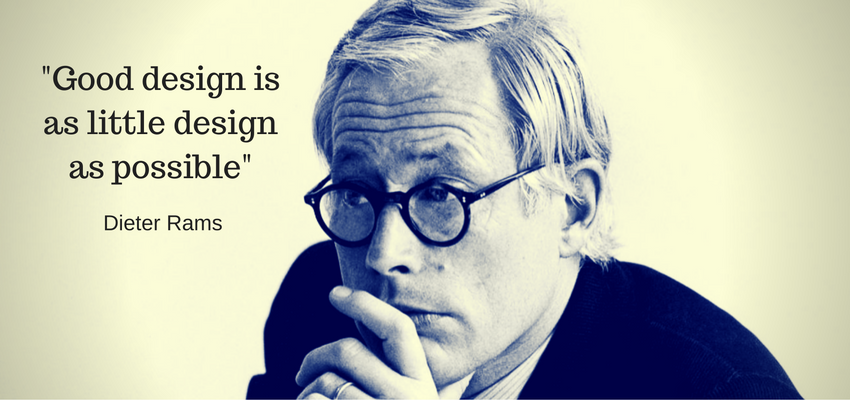
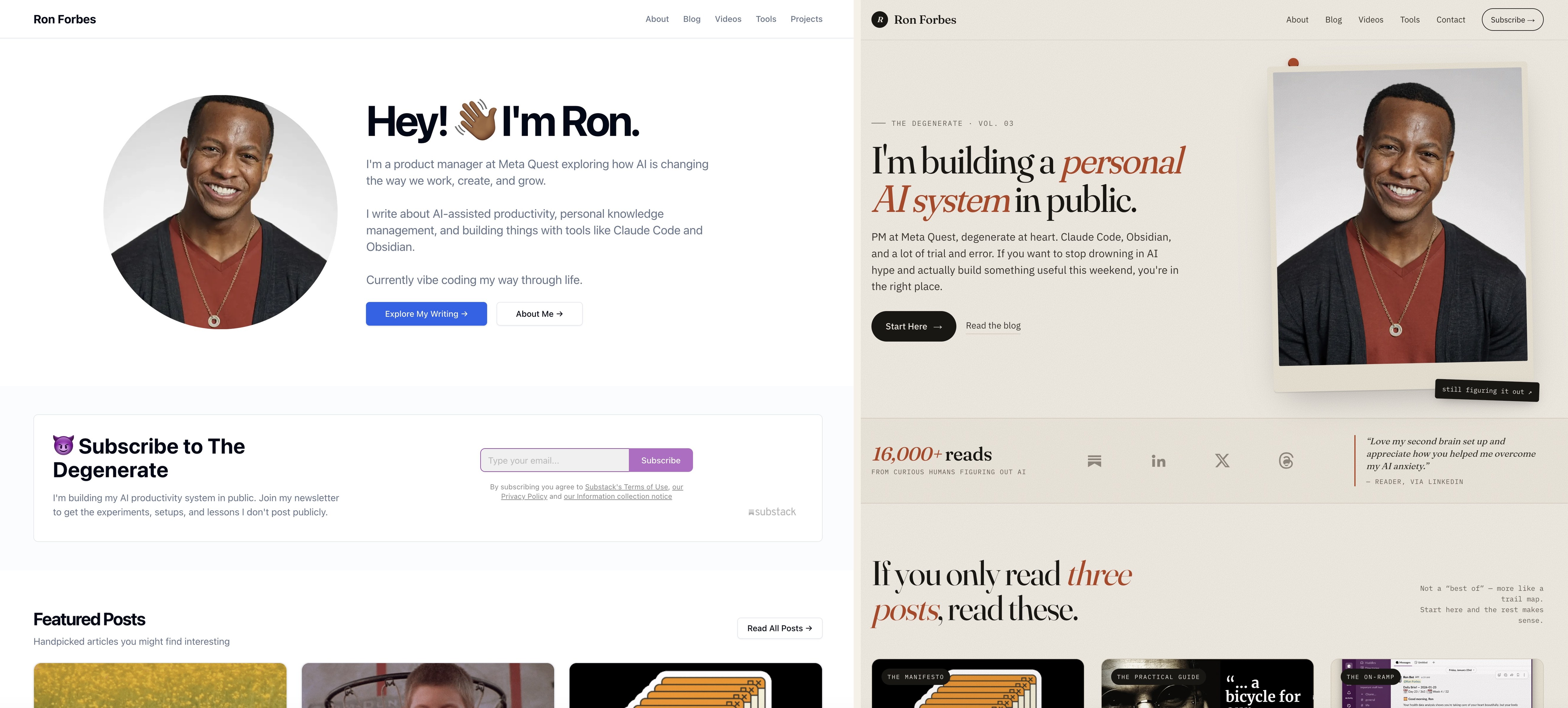
It's Sunday. I haven't posted in three weeks. I gave myself the grace to step back, and that felt right. But I'm back. And the first thing I want to tell you is that while I was offline, I rebuilt this entire website in an afternoon.
When I Rebuilt My Site, the News Was Layoffs
While I was rebuilding ronforbes.com, the headlines were brutal. Block announced it was cutting roughly 40% of its global workforce, about 4,000 jobs, with Jack Dorsey citing AI capability directly. Oracle eliminated somewhere between 10,000 and 30,000 roles in a single 6 a.m. email. Snap cut 16% of staff, about 1,000 people. The tech sector's Employee Confidence Index dropped 6.8 points year-over-year, the largest drop of any industry. Roughly 100,000 tech workers have been laid off in the first four months of 2026 alone, and almost half of those cuts are being attributed, fairly or not, to AI.
The instinct in moments like this is to feel small. To freeze. To polish the LinkedIn and wait it out. To feel powerless.
I get it. I felt it too.
But there's another instinct.
The Other Instinct
Two things are true at the same time. The floor is dropping out from under traditional knowledge work. And the ceiling on what one person can build is rising at exactly the same rate. Faster, actually.
The gap between those two lines is where agency lives.
A corner of the internet in your name. A skill set the layoff list can't touch. The thing you can point to when someone asks what you've been working on, that isn't owned by a company that might not want you next quarter.
The tools to plant your flag in that gap have never been more accessible. They got more accessible last Friday, in fact. And that's what I want to talk about.
The Series So Far, and the New Chapter
I've been writing a series on this site about the roles AI has quietly handed back to people who never had the credentials for them. The arc so far:
- You're an engineer now — vibe coding. PMs and tinkerers writing software they couldn't have shipped two years ago.
- You're a product manager now — taste, judgment, the 10-80-10 framework. The first 10% of perspective and the last 10% of voice are still yours; the 80% in the middle is now leverage.
- You're a people manager now — agent orchestration as the next chapter of management. The skills transfer, almost cleanly.
Engineering, product management, design — that triad has always defined how things get built. The series was missing one. Until last Friday.
On April 17, Anthropic launched Claude Design alongside Opus 4.7. It's positioned, in their own words, for "founders, product managers, and marketers without a design background" who need to turn an idea into something visual without learning Figma from scratch. The launch coverage carried a wild quote from Brilliant's senior product designer: pages that took 20+ prompts to recreate in competing tools needed only 2 prompts in Claude Design.
So here we are.
You're a designer now.

From the Trenches: The Redesign Retro
The Starting Point
A few months ago, I redesigned this site for the first time. I used Claude Code — basically a single tool, a terminal, a lot of prompts, and a lot of waiting. It took weeks. I shipped something I was proud of, but the experience was friction the entire way. I was constantly translating: this is what I see in my head, this is how I describe it in code, this is what got built, this is how it's different from what I wanted, repeat.
This time around, the design felt like it had stopped working for me. There were specific problems I wanted to solve:
- The content that resonates most — the posts I keep sending to friends, family, colleagues when they ask "how do I get started with agentic AI?" — was buried.
- I wanted to give people a roadmap. An on-ramp. A clear path from "I've heard about Claude" to "I'm using it for real work."
- The reading experience needed to be more pleasant. Better typography, more breathing room, easier to land on related content when you finish an article.
- I wanted to share more of who I am and what I've actually learned, in a way that might inspire someone else to take the same step.
- I wanted to talk about the tools I'm using and why I love them, because right now is the moment people need that map.
So I sat down to redesign it. And the experience was completely different.
Claude Design as the Exploration Surface
The interface is two panels: chat on the left, a live canvas on the right. You describe what you want. Claude builds a working version. You react. Iterate. Comment inline on specific elements. Use the sliders Claude generates for you to tune spacing, color, layout. Ask Claude to apply a change across the whole design.
I stopped describing and started reacting.
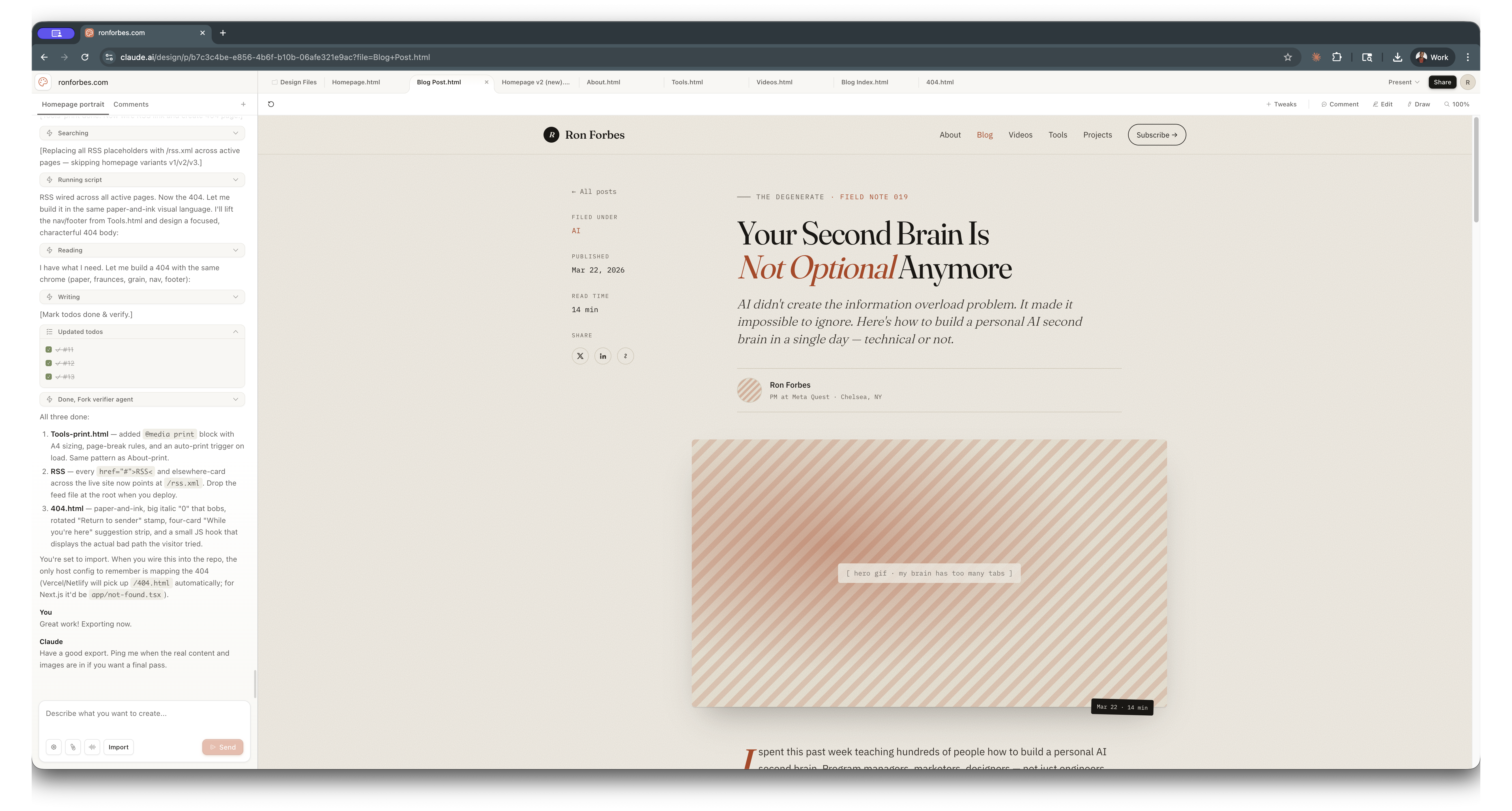
That's the part that mattered. December me had to hold the entire mental model of the site in my head and translate it into prompts blind. April me could see the thing being made and respond to it. The cognitive load dropped through the floor.
The Handoff Loop
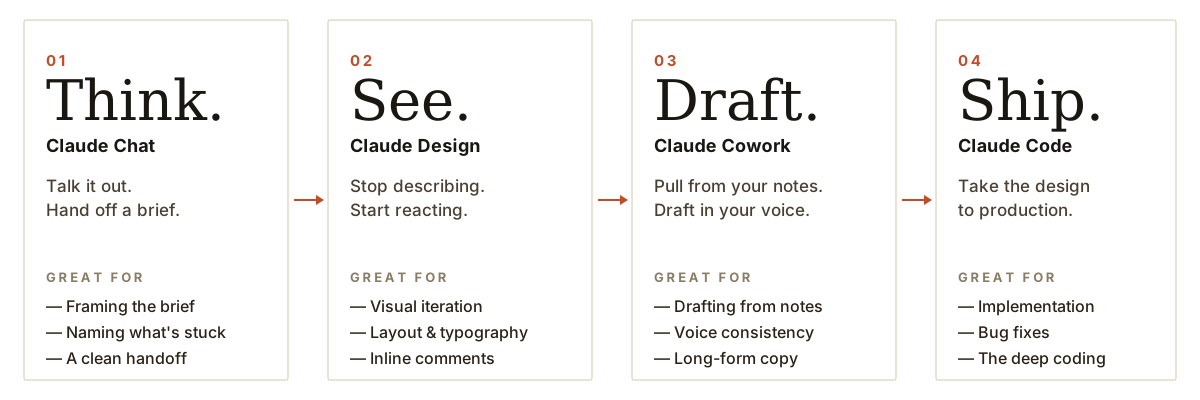
Here's what the workflow actually looked like, end to end:
- Claude Chat — ideation. I walked through the design problems out loud, what I was trying to solve, what was stuck. Had it write a handoff brief I could pass into Design.
- Claude Design — exploration. I took the brief into Design and started iterating on the canvas. Working through different pages, different layouts.
- Claude Cowork (with RonOS) — content fill. When I needed real copy, I went to Cowork and let it pull from my Obsidian vault. Two thousand notes of context. It wrote drafts that sounded like me because it had read everything I'd written.
- Back to Design — paste the content in, see how it looks, iterate.
- Export — when the design was where I wanted it, Claude Design packages everything into a handoff bundle that goes straight into Claude Code.
- Claude Code — implementation. Building out the site, fixing bugs, going back to Design when something needed visual rework.
- VS Code + Claude Code in the terminal — the deep coding work at the end.
The whole loop ran inside one ecosystem. Chat → Design → Cowork → Code, with the desktop app holding it all together. Not because I was committed to staying in one company's tools, but because the friction between them is gone. Designs are code underneath. Code can be redesigned in Design. Content in Cowork can be exported anywhere. The handoffs that used to cost me half a day each now cost me one click.
That's the part the announcements don't capture. It's not just that Claude Design is good. It's that the gap between four different tools collapsed into one continuous conversation across three Claude surfaces.
The Reality Check
Here's the part I want to be honest about: the tools did more, but they didn't decide anything.
They didn't decide to remove my resume page and lean into Career Highlights instead. They didn't pick "vibe coding" as the phrase. They didn't write the design brief — I did, after weeks of paying attention to what wasn't working. They didn't choose to put my best three or four posts at the top of the site. They executed faster on decisions I'd already made, and decisions I made faster because I could see the consequences immediately.
That's the 10-80-10 again. The first 10% is still you knowing what you want. The last 10% is still you knowing whether it's good. The middle 80% just got cheaper than it's ever been.
Jamaica
Once a year, I teach a class on coding to a school in Jamaica. The island, not the neighborhood in Queens. I did it again this past week, over video.
What I left them with — what I keep coming back to — was simple. Be curious. Get started from now. Exercise the agency you have.
The thing that stuck with me wasn't anything I taught them. It was watching them. The creativity. The total absence of self-consciousness about not knowing how. The willingness to just try the thing. I'm certain some of those kids are going to build the next breakthroughs in technology. I learned more from them than they did from me.
We can all learn from that. Childlike curiosity, childlike creativity, childlike agency — those are the ingredients. Especially right now. Especially with everything that's happening in the industry.
The headlines this month are going to keep being brutal. The layoffs aren't done. The sector confidence chart isn't pointing up. But the tools to plant your flag have never been more accessible. The roles you used to need credentials for — engineer, product manager, people manager, designer — are quietly being handed back to anyone willing to pick them up.
The kids in Jamaica aren't waiting for permission. Neither should you.
You're a designer now.
Build the corner of the internet that has your name on it. Start today. Start small. Start ugly. Just start.
I'm building my AI productivity system in public. Join my newsletter to get the experiments, setups, and lessons I don't post publicly.
Get the Obsidian + Claude Code starter vault. Coming soon
The setup I use to run my life — MCP servers, daily briefs, templates. Free when you subscribe to The Degenerate.
You Don't Have to Wait for KAIROS
A leaked Claude Code daemon called KAIROS and Karpathy's viral knowledge base blueprint just revealed the future of personal AI. Here's what's actually working today, and how to start building it this weekend.
The Week the Proactive AI Assistant Went Mainstream
Claude shipped computer use, Dispatch, Channels, and scheduled tasks in eight weeks, replicating what previously required OpenClaw and a self-hosted server. Here's what changed and how to set it up.
Your Second Brain Is Not Optional Anymore
AI didn't create the information overload problem, it made it impossible to ignore. Here's how to build a personal AI second brain using Claude Cowork or Claude Code in a single day, whether you're technical or not.
Stop Learning AI. Start Learning Management.
The most important skill for working with AI agents isn't technical. It's people management. How frameworks from Julie Zhuo and Kim Scott transformed my AI workflows.